
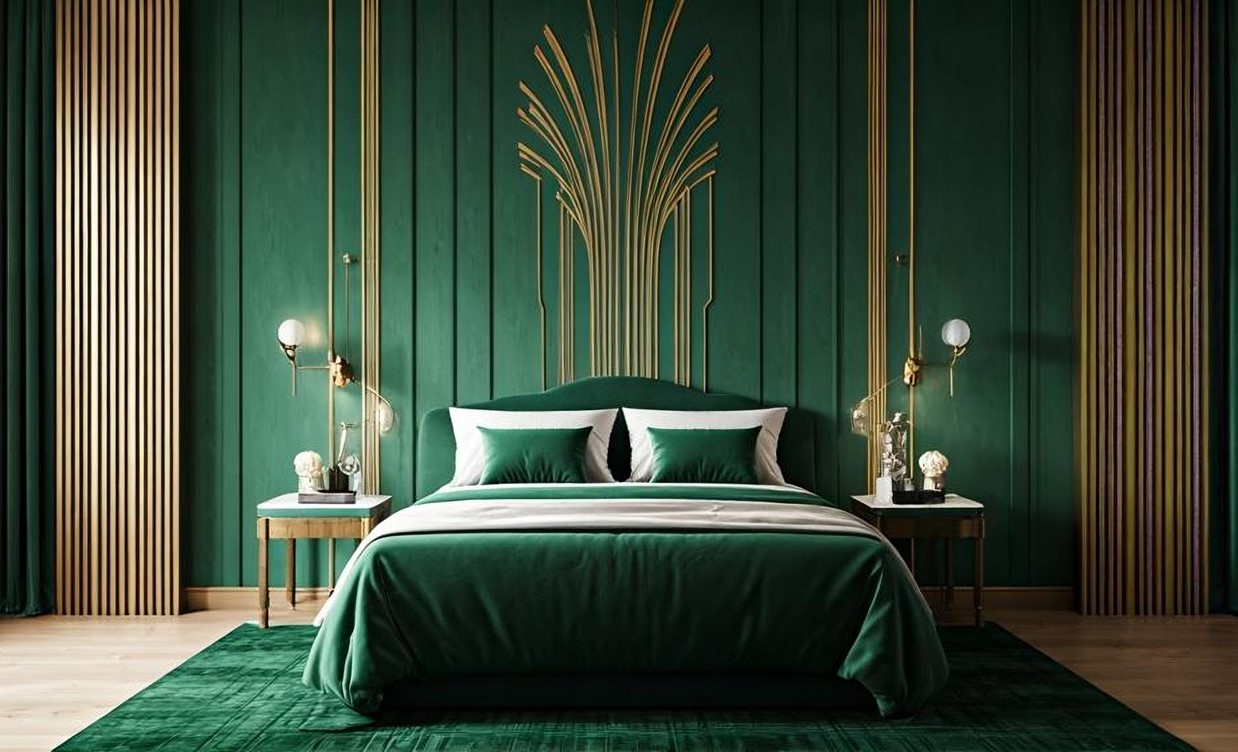
In the pantheon of interior design styles, few trends possess such a distinct identity and timeless appeal as Art Deco . It’s not just an aesthetic; it’s a manifesto of an era—an echo of the Roaring Twenties, the Jazz Age, growing metropolises, and a boundless belief in progress. Art Deco interiors are like precisely composed pieces, in which each element plays its part, creating a harmonious whole full of drama, elegance, and refined luxury. This is a style for the bold, who value quality, order, and unconventional ornamentation, which, even today, a century after its birth, remains synonymous with good taste.
Understanding its essence requires a journey back in time, to a moment when a world, weary of the fluid, organic lines of Art Nouveau, yearned for discipline, symmetry, and the power of geometry. Contemporary designs inspired by this trend prove that its principles remain relevant, offering a unique recipe for an interior with soul and character.
The birth of the Art Deco style
The style’s name comes from the 1925 Paris International Exhibition of Decorative Arts and Modern Industrial Design , but its roots go deeper. Art Deco was a direct response to the chaos of World War I and the sentimental, whimsical aesthetics of Art Nouveau. It expressed a collective desire for stability, order, and optimism, manifested through the pursuit of perfection of form and the celebration of modernity.
Where Art Nouveau drew from nature—its motifs included supple stems and sinuous, asymmetrical lines—Art Deco sought inspiration in the machine, the rhythm of the city, and ancient, monumental civilizations. A breakthrough moment that forever shaped the visual language of the style was the discovery of Tutankhamun’s tomb by Howard Carter in 1922. This event sparked a global “Egyptomania,” introducing motifs like lotus flowers, scarabs, and hieroglyphic patterns into interiors. A fascination with African and Japanese art, from which lacquer techniques were drawn, had an equally strong influence. Avant-garde artistic movements such as Cubism and Futurism also influenced the geometrization of forms.
The fundamental difference was the approach to line: the organic, sinuous shape was replaced by a straight, dynamic line, a sharp angle, and a disciplined arc. The Art Deco philosophy was based on the belief that luxury could go hand in hand with functionality, and that craftsmanship should be evident in every detail.
Key Features of the Art Deco Style – An Alphabet of Luxury and Order
The Art Deco identity is inextricably linked to its distinctive palette of materials, colors, and patterns. Together, they create a coherent visual language that is both rich and structured.
A palette of luxurious materials
The Art Deco era embraced gloss, smooth surfaces, and exotic textures. Materials were meant not only to look expensive but, above all, to convey quality and masterful craftsmanship.
- Noble woods: Exotic woods were the foundation of furniture making. Dark rosewood, ebony, or mahogany, often finished with a high-gloss varnish, formed the basis for chests of drawers, tables, and armoires. These were often decorated with intricate inlays —patterns of ivory, mother-of-pearl, or other woods.
- Shiny metals like chrome, brass, silver, and stainless steel brought a cool, modern glow to interiors. They appeared as furniture fittings, lamp bases, mirror frames, and balustrade elements.
- Natural Stone: The monumentality of the style was expressed through the use of stone. Polished marble and granite , often in contrasting black and white, adorned floors, countertops, and stately fireplace mantels.
- Luxurious fabrics: Furniture upholstery and textiles had to keep pace with the rest. Thick, heavy velvets and velours reigned supreme , as did smooth, shimmering satins and silks.
- Glass and mirrors: Art Deco loved the play of light. Faceted mirrors, or mirrors with polished edges, enhanced the sense of space, while crystal and opal details on lamps diffused light, creating a spectacular effect.
Defining color palette
The color scheme is fundamental to this style and is based on a play of contrasts and deep, saturated colors that emphasize the luxurious character of the arrangement.
- Base: The foundation is most often formed by strong, contrasting combinations of black and white . Equally popular are neutral, elegant backgrounds in shades of ivory, cream, and beige, which provide the perfect frame for more expressive elements.
- Metallic accents: the shimmer of gold, brass, silver, and chrome are an integral part of the palette. Metallic finishes add a touch of glamour and modernity to interiors.
- Gemstone colors: Deep, saturated gemstone hues— emerald green, sapphire garnet, ruby red, and amethyst purple— appear as color accents . They add depth and drama to interiors.
Geometry, symmetry and the world of motifs
If materials and colors are the alphabet of Art Deco, then geometry and symmetry constitute its grammar. Symmetry is absolutely fundamental. Furniture arrangements are often mirror images: two identical sofas, a pair of armchairs flanking a fireplace, two sconces on either side of a mirror. All of this creates an impression of order, harmony, and effortless elegance.
On this symmetrical canvas, a love of ornamentation flourished. The patterns that defined the era included:
- Pure geometry: Zigzags (chevrons), rhombuses, triangles and stepped forms inspired by ziggurats.
- Solar motifs: Sun rays ( sunburst ) decorating mirrors, clocks and furniture details.
- Stylized flora and fauna: In addition to geometry, figurative motifs were also popular. Slender greyhounds, gazelles, and panthers appeared—symbols of speed and elegance. Geometric versions of roses, lilies, and ginkgo leaves were popular among floral motifs.
- The human figure: Images of dynamic, athletic figures, especially women’s, referred to the emerging sports culture and fascination with the body.
Design Icons – Masters Who Defined Art Deco
The Art Deco style was not anonymous. Its most refined creations were created by distinguished designers and artists whose names remain synonymous with luxury and artisanal perfection to this day.
- Émile-Jacques Ruhlmann: Considered the “god” of Art Deco furniture, his ebony and rosewood designs, inlaid with ivory, are the quintessence of Parisian chic and an unrivaled model of luxury.
- Jean Dunand: A master of lacquer and metalwork, he was renowned for creating monumental, decorative screens and panels that combined exotic inspirations with geometric precision.
- René Lalique: A genius of glass art. His vases, perfume bottles, lamps, and decorative panels in satin-finished, opalescent glass brought a poetic yet modern dimension to interiors.
- Tamara de Łempicka: Although she was a painter, her style is inextricably linked to the aesthetics of the era. Her portraits, with their cool colors, sharp contours, and sculptural modeling, provide excellent inspiration for the atmosphere and color palette of Art Deco interiors.
Art Deco in Every Room – Practical Interior Design Tips
Bringing the Art Deco aesthetic into your home requires a well-thought-out strategy. Here’s how to adapt this style to individual rooms to achieve a cohesive and elegant effect.
The living room – the heart of the home
The focal point of a living room is often a fireplace with a sumptuous marble or granite surround. It’s a good idea to organize the relaxation area symmetrically around it, arranging a sofa and armchairs with geometric, rounded shapes, upholstered in velvet. A coffee table with a veneered top and chrome base will complete the look. Lighting is key – a spectacular, cascading chandelier will become the interior’s jewel.
Bedroom – an oasis of peace
In the bedroom, the bed plays the starring role, especially its headboard. It can be high, upholstered in velvet and geometrically quilted, or veneered in exotic woods. Next to the bed are symmetrically arranged bedside tables with rounded corners and metal handles. An elegant dressing table with a large, three-part mirror is an essential element.
Bathroom – private spa
An Art Deco bathroom is synonymous with luxury. Marble, often in a black-and-white checkerboard pattern, or geometric tiles, such as the corsets popular during the era, dominate the floors and walls. Gold or chrome fixtures with angular shapes, faceted mirrors, and opal glass sconces create the ambiance of an elegant bathroom.
Hall and entryway – a promise of elegance
The hallway is the showpiece of the home. A few elements are all you need to create a grand entrance: a narrow console table on metal legs, a large sunburst mirror above it , and a striking ceiling lamp or a pair of wall sconces that will emphasize the entrance’s symmetry.
Art Deco in Polish – where to look for inspiration?
Although Art Deco is primarily associated with Paris and New York, the style also left a distinct mark in Poland. A prime example is the architecture of Gdynia – a city built in the 1920s and 1930s, where the modernist building forms are often enriched with Art Deco details such as streamlined corners, geometric reliefs, and elegant portals. Inspiration can also be found in the interiors of Warsaw tenement houses from this period, with their characteristic corset floors, wrought-iron balustrades, and door joinery. This legacy lives on, inspiring contemporary Polish artisans and designers to create furniture and accessories reminiscent of the golden age of elegance.
The art of subtlety – how to introduce art deco into a contemporary interior?
Adapting such a distinctive style to contemporary realities can be a challenge. The key is moderation and wise selection to avoid theatrical set design.
Style in accessories – great effect without a major renovation
You don’t need a complete renovation to experience the Art Deco spirit. Sometimes, carefully selected accessories are enough to create the desired atmosphere.
- Textiles: Velvet cushions with geometric gold embroidery, curtains with a fan motif or heavy, smooth emerald curtains.
- Wall decorations: Graphics and posters inspired by the style of the era, and above all mirrors in decorative, geometric or solar frames.
- Small furniture: A golden bar on wheels, a velvet pouffe with a geometric shape or a side table with a marble top.
- Glass and tableware: Glasses with a geometric cut, gold cutlery or porcelain with delicate gold decorations.
A modern interpretation – the key to timeless elegance
A modern approach to Art Deco is about capturing its spirit rather than copying historical arrangements. A skillful combination of symmetry, selective decoration, and functionality allows you to leverage the luxurious nature of the style while avoiding overload. Instead of decorating your entire apartment in a 1920s aesthetic, it’s worth focusing on a few strong, distinctive elements. In a minimalist living room, a veneered console on chrome legs and a sunburst mirror are enough to give it a refined feel.
The contemporary Art Deco style is all about detail and quality. It can be successfully combined with minimalism or modern style, where its geometric forms and luxurious materials become a distinctive yet unpretentious accent. It’s proof that true elegance is timeless. Its strength lies in the perfect blend of discipline and decorativeness, luxury and order. Introducing it into an interior is a declaration of good taste and the courage to create a space that is both functional and undeniably beautiful.

Signature Estates editorial team